


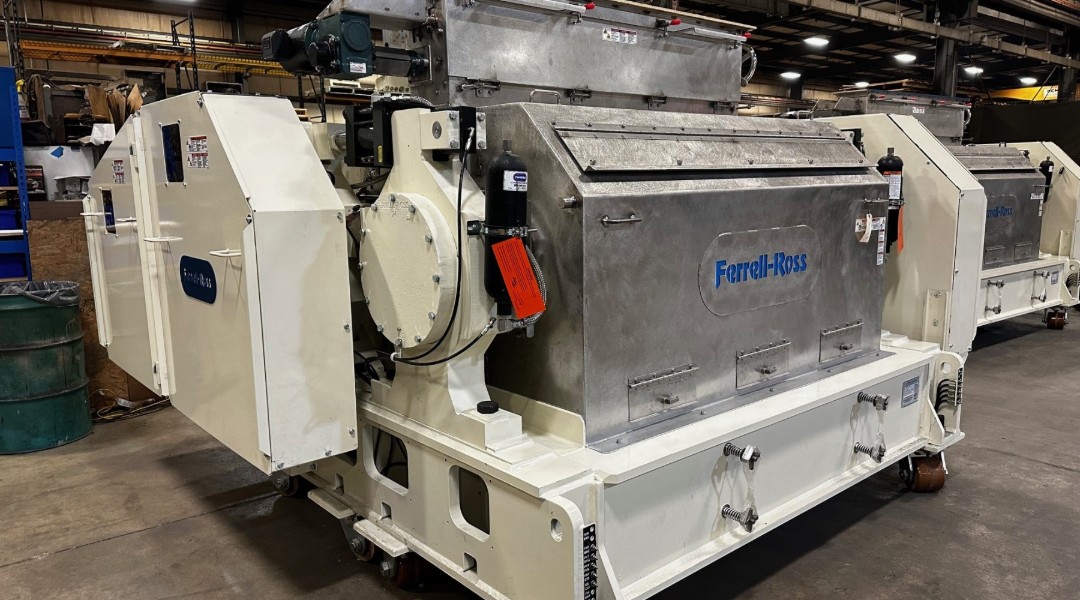
In this week’s installment of our recurring machine-introduction series, we are featuring the Ferrell-Ross Pinnacle Series in 24×56 and 32×68 configurations. Manufactured in Bluffton, Indiana, these steam flaking mills combine high-volume capacity with heavy-duty construction, precise roll control, and a ready-to-integrate design intended to simplify installation.
The Pinnacle Series is engineered for large-scale food, feed, and fuel processing applications where consistent flake quality, dependable material reduction, and practical maintenance access matter. Along with the specifications listed on the cut sheet, several design choices help reduce field installation variables, electrical demand, and long-term drivetrain stress.
Two Configurations for High-Capacity Steam Flaking
Matching mill capacity to the process is an important first step in equipment selection. The Pinnacle Series is available in two configurations:
- 24×56 Pinnacle Series: Features 24-inch-diameter by 56-inch-wide chilled cast iron rolls and produces up to 28 TPH.
- 32×68 Pinnacle Series: Features 32-inch-diameter by 68-inch-wide chilled cast iron rolls and produces up to 40 TPH.
Actual production depends on the grain, conditioning, target flake characteristics, upstream and downstream equipment, and other application-specific factors. Both models are designed to distribute material across the roll face and maintain the controlled pressure required for consistent flake thickness and density.
Preassembled and Factory-Tested for Streamlined Integration
A key Pinnacle Series advantage begins before the mill enters production. The machine arrives preassembled and factory-tested, with pre-mounted motors and a unitized base that support a streamlined, ready-to-integrate installation approach.
Older Flakemaster installations typically required a two- to three-person millwright crew to assemble and align major components in the field. By completing more assembly, setup, and testing at the factory, the Pinnacle Series can significantly reduce the installation and commissioning work required on site. Final placement, utility connections, process integration, and startup verification remain specific to each facility.
This approach is particularly valuable for retrofit projects and facilities operating within planned shutdown windows. It shifts critical alignment work into a controlled manufacturing environment and reduces the number of variables that must be resolved on the plant floor.
Unitized Base and Factory-Aligned Drive
The unitized base provides a common structural foundation for the mill and drive components. The drive is aligned at the factory rather than relying on field assembly to establish the relationship among the motor, belts, and sheaves.
Proper belt and sheave alignment is important because field variation can create uneven belt loading, vibration, heat, and additional forces within the drivetrain. Over time, those conditions can contribute to drivetrain stress and premature wear. Factory alignment removes many of these field variables, although normal inspection, belt-tension checks, and preventive maintenance remain essential throughout the machine’s service life.
High-Strength Frame and Precision Bearing Support
Steam flaking places substantial forces on a mill frame and roll assembly. The Pinnacle Series uses a high-strength structural steel frame designed to maintain mechanical stability under demanding loads. Precision-machined, heavy-duty steel bearing housings support the rolls and help preserve alignment across the working face.
Double-row, self-aligning spherical roller bearings accommodate operating loads while supporting controlled roll movement. Together, the frame, bearing housings, and bearings provide a rigid mechanical platform for repeatable roll-gap control and long-term service.
Chilled Cast Iron Rolls and Roll Pre-Heat
At the center of each mill are high-quality chilled cast iron rolls: 24 inches in diameter by 56 inches wide for the 24×56 and 32 inches in diameter by 68 inches wide for the 32×68. Their surface hardness and toughness are suited to the abrasion and pressure involved in steam flaking.
A standard roll pre-heat system, which requires a steam connection, brings the rolls toward operating temperature before conditioned grain enters the nip. This helps reduce abrupt thermal changes at startup and supports more stable flake production as the process reaches operating conditions.
Hydraulic Roll Tension, Positive Stops, and Protection
Both Pinnacle configurations use 6-inch-bore hydraulic cylinders to generate the linear roll pressure required for uniform flake thickness and density. The hydraulic system provides controllable, repeatable tension while supporting roll protection.
- Hydraulic roll tension: Maintains controlled pressure across the roll assembly.
- Fixator positive roll stops: Establish repeatable mechanical limits for roll positioning.
- Hydraulic accumulator roll protection: Allows the system to respond if tramp material enters the roll nip, helping protect critical components.
- Air-over-hydraulic pump: Includes electric and manual four-way valve control for practical operation and service.
These features work together to manage roll position and pressure without implying that normal inspection, upstream tramp-material controls, or preventive maintenance can be eliminated.
Dual HTD Drives and Lower-Horsepower, Higher-Torque Motors
The Pinnacle Series uses a dual HTD drive configuration to provide positive power transmission and appropriate roll surface speeds. Adjustable motor bases support drive setup and service, while cabinet-style OSHA-type drive guards help isolate moving components.
The pre-mounted motors use a higher-torque, lower-horsepower design that reduces electrical demand compared with higher-horsepower arrangements used on older mill designs. For the 32×68 Pinnacle Series only, reported potential electrical savings may reach up to $10,000 per year compared with a Flakemaster, depending on the selected configuration and operating conditions.
This figure is a qualified estimate, not a guaranteed result. Actual electrical savings vary with operating hours, local utility rates, motor load, application, equipment configuration, maintenance condition, and other site-specific factors. Facilities should evaluate anticipated energy use against their own operating profile and electrical rates.
Stainless Steel Product-Zone Components
Critical product-zone components use stainless steel to improve corrosion resistance and facilitate routine cleaning. Standard stainless steel elements include the mill housing roll covers, housing center section, roll scraper assemblies, and peg feeder.
The stainless steel roll scraper assemblies use aluminum blades to remove material from the roll surfaces and limit accumulation in the discharge area. These material and design choices support practical sanitation and maintenance, but they do not state or imply that the machine itself is FDA approved.
High-Capacity Peg Feeder and Material Distribution
A consistent feed curtain helps distribute work across the full roll face. The standard stainless steel peg feeder meters conditioned grain into the mill and includes an adjustable slide gate. An adjustable internal deflector provides another means of controlling material distribution.
Uniform feeding can help stabilize roll loading, reduce concentrated wear, and support consistent flake characteristics. Final feeder settings depend on grain condition, throughput, target flake density, and the surrounding process.
Inspection, Sampling, Lubrication, and Guarding
The Pinnacle Series includes practical features intended to support routine operation and maintenance:
- Two roll inspection doors provide access for checking roll and feed conditions.
- Product sampling doors allow operators to collect and evaluate processed material; sample-door location may vary by model.
- A convenient central greasing system groups lubrication points in an accessible location.
- Cabinet-style OSHA-type drive guards cover drive components while supporting service access.
These features can make regular checks and preventive maintenance more straightforward, helping plant teams follow established service procedures.
Pinnacle Series Standard Features
The cut-sheet specifications for the 24×56 and 32×68 Pinnacle Series include:
- High-quality 24-inch- or 32-inch-diameter by 56-inch- or 68-inch-wide chilled cast iron rolls
- Mill frame constructed from high-strength structural steel
- Stainless steel mill housing roll covers
- Stainless steel mill housing center section
- Two roll inspection doors
- Hydraulic roll tension
- Fixator positive roll stops
- Hydraulic accumulator roll protection
- Air-over-hydraulic pump with electric and manual four-way valve
- Heavy-duty steel bearing housings
- Double-row, self-aligning spherical roller bearings
- Dual HTD drive
- Adjustable motor bases
- Cabinet-style OSHA-type drive guards
- Stainless steel roll scraper assemblies with aluminum blades
- Stainless steel peg feeder with adjustable slide gate
- Adjustable internal deflector
- Convenient central greasing system
- Product sampling doors
- Roll pre-heat system requiring a steam connection
A Practical Approach to High-Volume Flaking
The Ferrell-Ross 24×56 and 32×68 Pinnacle Series pair their published capacities and standard features with a practical installation strategy. Preassembly, factory testing, a unitized base, factory-aligned drives, and pre-mounted motors can reduce field work while limiting alignment variables that may affect drivetrain service life.
Once in operation, high-strength structural construction, chilled cast iron rolls, hydraulic tension and protection, stainless steel product-zone components, and accessible maintenance features support demanding steam flaking applications. The higher-torque, lower-horsepower motor design also gives facilities a specific path to reduce electrical demand, with results determined by the selected configuration and actual operating profile.
Conclusion
This week’s featured machines—the Ferrell-Ross 24×56 and 32×68 Pinnacle Series steam flaking mills—are designed for processors that need capacity, controlled flake production, and a more streamlined path from delivery to integration. The 24×56 produces up to 28 TPH, while the 32×68 produces up to 40 TPH, subject to application conditions.
To discuss capacity requirements, installation planning, electrical demand, or how a Pinnacle Series configuration may fit your process, contact Ferrell-Ross for an application-specific evaluation.