


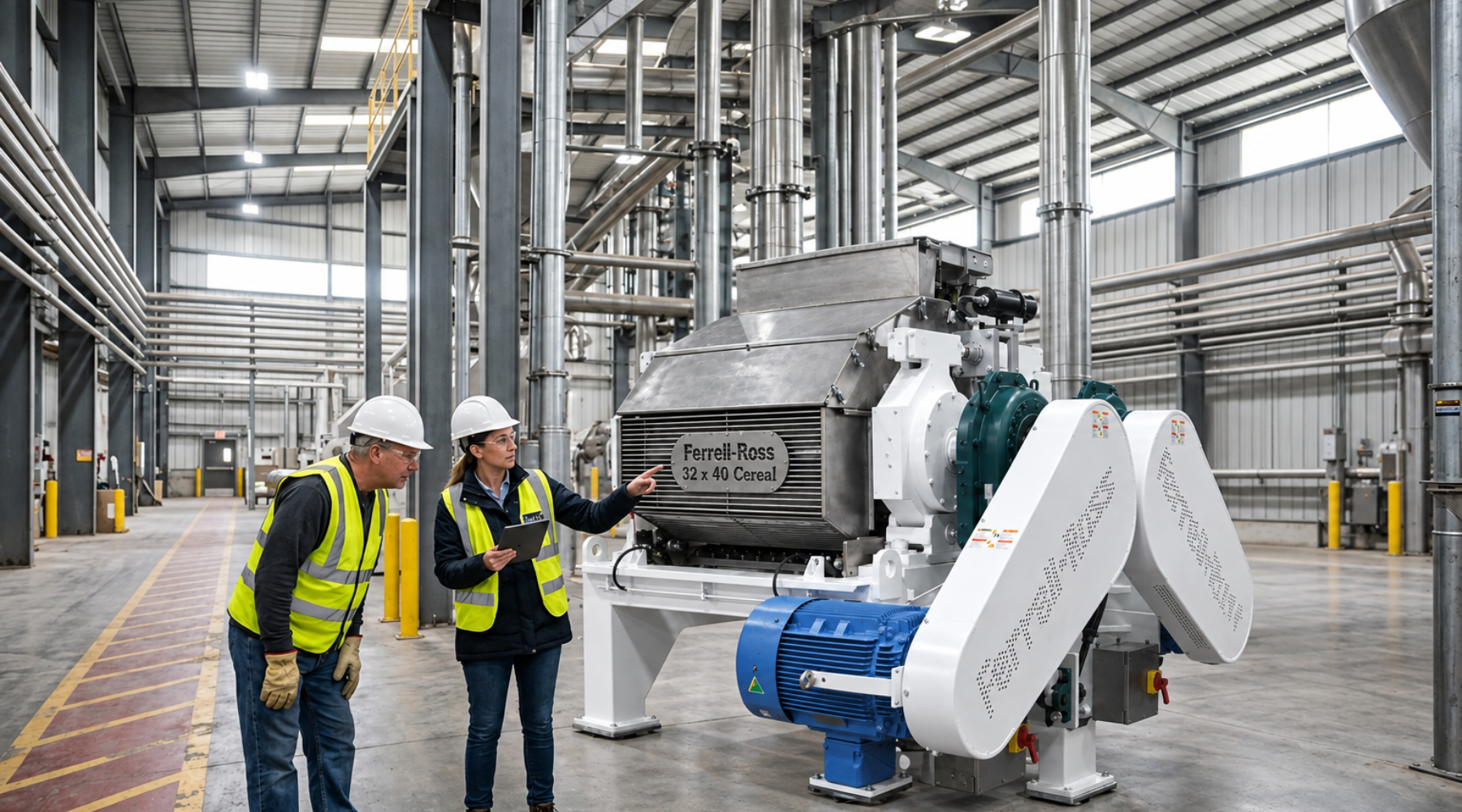
In commercial cereal flaking operations, processing equipment must provide mechanical stability, repeatable roll control, and straightforward servicing. Whether preparing flakes for ready-to-eat breakfast cereals or processing specialized grain formulations, operating teams face the continuous challenge of maintaining exact roll positions under heavy mechanical loads. Plant managers, facility engineers, and operators often ask: how does machine construction directly affect roll-gap accuracy, drive reliability, and daily maintenance access?
The Ferrell-Ross 32×40 Cereal Mill addresses these core manufacturing demands through targeted mechanical engineering. Manufactured in Bluffton, Indiana, by A.T. Ferrell Company Inc., this mill pairs heavy structural fabrication with precision-machined alignments and intuitive operator controls. Examining the documented mechanical features of the 32×40 cereal mill reveals how its drive layout, roll metallurgy, scraper architecture, and maintenance provisions support demanding cereal processing environments.
Dual 60 HP Drive Power for Continuous Operation
Industrial cereal processing requires substantial mechanical torque to draw conditioned grain through the reduction nip without stalling or bogging down. The Ferrell-Ross 32×40 Cereal Mill incorporates dual 60 HP drives as standard equipment, providing balanced, dedicated power across the roll set. Distributing power via two independent drive motors ensures that ample rotational force is delivered directly to each roll journal.
Torque transmission is managed through two shaft-mounted gear reducers paired with dual motor drive components. This arrangement eliminates complex external geartrains while ensuring positive speed control under high continuous loads. The entire drive architecture is protected by enclosed drive guards, keeping power transmission components fully shielded during active production runs. Operating teams benefit from a robust drivetrain designed to handle the rigorous physical demands of cereal reduction without mechanical compromise.
Roll-Gap Precision and Machined Structural Stability
Uniform particle reduction and consistent flake integrity require a rigid structural platform. If a mill frame deflects under separating forces, the gap between rolls widens unevenly, causing immediate drift in product sizing and uneven roll face wear. The 32×40 mill frame is built from a heavy mild steel base finished with epoxy white paint, paired with an upper stainless steel mill housing featuring continuous welds ground smooth for sanitary process compatibility.
To achieve exceptional mechanical precision, the mill frame and bearing housing mounting surfaces are precision-machined after fabrication. Machining these interfaces after welding eliminates structural distortion introduced during the welding process, ensuring true geometric alignment between the rolls. The assembly utilizes SKF double-row, self-aligning spherical roller bearings, which absorb heavy radial loads while accommodating minor shaft deflections without binding.
Parallel roll positioning is established and preserved using documented mechanical and hydraulic systems:
- Fixator Positive Stop Roll Gap Adjustment: Provides a rigid, repeatable physical limit that prevents roll-to-roll contact and maintains exact gap tolerances.
- Air-Over-Hydraulic Pump: Equipped with both electric and manual valves to control roll positioning and hydraulic engagement efficiently.
- Nylon Roll Saddles: Support smooth, guided travel of the moveable roll assemblies while damping operational vibration.
At the center of this reduction platform are 32-inch diameter peripherally drilled chilled cast iron rolls. Peripherally drilled internal cooling channels allow chilled water to circulate directly beneath the roll working surface via two dedicated rotary unions. This fluid circulation helps stabilize roll surface temperatures during extended processing runs, mitigating thermal expansion that could otherwise alter the roll gap.
Accurate Roll Scraper and Knife Adjustment
During cereal flaking, cooked or conditioned grain can stick to the roll surfaces. Without continuous, clean blade contact, material wraps around the rolls, degrading product quality, increasing motor load, and creating operational bottlenecks. The 32×40 cereal mill features an improved, air-actuated roll scraper assembly designed for precise mechanical calibration.
The scraper assembly allows fine tuning of both the blade angle and the exact point of roll contact across the 40-inch roll face. Operators can adjust the scraper position to ensure clean, low-friction shedding of processed flakes without applying excessive mechanical pressure that could prematurely wear the roll face or scraper knife. The air-actuated mechanism provides consistent, regulated pressure against the roll, ensuring uniform cleaning across the entire width of the working surface.
Enhanced Maintenance and Service Access
Equipment longevity and continuous plant uptime depend heavily on practical service access. Routine inspection of the roll face, knife clearances, and internal housing condition must not require extensive disassembly. The Ferrell-Ross 32×40 Cereal Mill incorporates redesigned roll guards that meet stringent industrial safety guidelines while facilitating routine maintenance tasks.
These redesigned guards allow direct maintenance access to the roll scraper adjustments and knife warping bolts without requiring full guard removal. Maintenance technicians can inspect blade contact, adjust knife tension, and verify roll surfaces quickly during planned changeovers. Furthermore, the smooth, continuously welded stainless steel housing minimizes product hang-up points, streamlining interior sanitation and washdown procedures.
Controlled Feeding and Material Distribution
Consistent roll performance requires a uniform material curtain across the entire 40-inch roll width. Clumping or channeling feed toward the center causes uneven roll wear, localized heating, and inconsistent flake thickness. The 32×40 cereal mill utilizes an integrated vibratory feeder equipped with a stainless steel pan and three electromagnetic drives.
Feed metering is controlled through a dedicated vibratory feeder control package featuring three individual trimmers and one main rheostat. This electrical control arrangement gives plant operators precise management over the feed stream:
- Main Rheostat: Sets the overall throughput speed and volume entering the mill.
- Individual Trimmers: Allow operators to balance the amplitude of each of the three electromagnetic drives across the width of the pan, establishing a uniform curtain across the roll face.
Documented Features Versus Application Outcomes
While the mechanical specifications of the Ferrell-Ross 32×40 Cereal Mill are strictly documented, finished product outcomes remain dependent on specific facility variables. Actual throughput tonnage, finished flake thickness, bulk density, and starch gelatinization levels depend on upstream conditioning, steam quality, retention time, grain variety, and moisture content. Similarly, total electrical consumption depends on utility rate structures, motor loading, and daily operating hours.
By understanding the direct relationship between documented engineering features and your plant’s operational parameters, facility engineers can design predictable, dependable processing lines that maintain integrity across long production campaigns.
Discuss Your Process Requirements with Ferrell-Ross
Selecting the right flaking equipment requires aligning mechanical specifications with dynamic plant realities. Built on 156 years of American craftsmanship and industrial engineering in Bluffton, Indiana, Ferrell-Ross provides precision-engineered processing equipment designed for longevity in demanding industrial environments.
To review your specific cereal flaking application, evaluate material handling requirements, or discuss technical configurations for the 32×40 Cereal Mill, contact the engineering and technical team at Ferrell-Ross today. Let our processing specialists help configure an equipment solution tailored directly to your operational goals.