


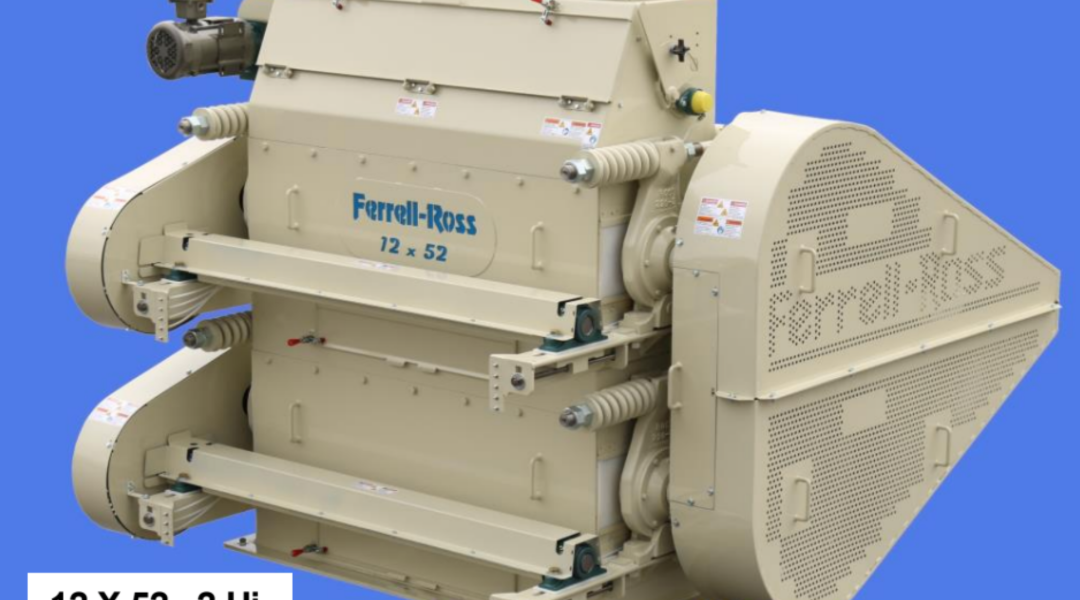
In high-capacity material reduction lines across the food, animal feed, cereal, oilseed, and biofuel processing sectors, product quality depends heavily on tight particle size distribution. While coarse grinding or preliminary cracking can be handled effectively on single-pair systems, many downstream processes demand a finer particle reduction without generating excessive, problematic dust. Whether conditioning oilseeds for downstream extraction, sizing cereal grains for consistent cooking, or milling feed grains for uniform bulk density, uncontrolled fines represent lost yield, pneumatic conveying issues, and compromised finished product quality.
When operations require both fine particle reduction and a uniform grind with minimal fines, multi-stage processing is the proven industrial approach. The Ferrell-Ross 2 Hi Industrial Roller Mill provides two successive pairs of rolls within a single, integrated processing footprint. By dividing the reduction ratio into two distinct steps, facility managers, process engineers, and plant operators can use the appropriate roller-mill configuration for precision particle reduction while avoiding the fines generation inherent in high-speed impact mills.
When Finer Particle Reduction Demands a Two-Pair Mill
Industrial size reduction is always a balance between shearing, compression, and energy input. When material is forced through an excessively aggressive single reduction step, internal stresses cause the particles to shatter rather than shear cleanly. This pulverizing action generates high volumes of unwanted fines and unrecoverable dust.
According to the Ferrell-Ross product literature titled 4. 2-Hi Industrial Mill, Single Hi industrial mills are ideal when finished product requires a coarse nature. However, when target specifications call for finer, uniform end products, the two-stage reduction of a 2 Hi mill provides substantial process advantages:
- Staged Particle Breakdown: The top pair of rolls performs an initial coarse crack or break, conditioning the material and establishing a consistent particle stream for the lower pair.
- Controlled Final Sizing: The bottom pair of rolls executes the secondary reduction, shearing the pre-cracked material down to the exact final profile required.
- Fines Mitigation: Distributing the total reduction ratio across two distinct nip points prevents localized overheating and excessive shattering, preserving particle uniformity.
- Process Adaptability: Operators can balance the workload between the upper and lower rolls to accommodate varying moisture contents, grain varieties, or incoming material densities.
Heavy-Duty Construction and Roll Metallurgy
The foundation of consistent material reduction is mechanical rigidity. Any deflection across the frame or rolls alters the nip gap, resulting in inconsistent particle sizing from one side of the machine to the other. Ferrell-Ross manufactures the 2 Hi Industrial Roller Mill with a heavy-duty steel housing designed to absorb continuous operational loads and dampen vibration.
At the center of the mill are chilled cast-iron rolls supported by heavy-duty forged-steel shafts. Chilled cast iron provides superior surface density and wear resistance, maintaining proper profile geometry over long production campaigns. Per Ferrell-Ross engineering standards, roll hardness is carefully held within the 48 to 54 Rockwell C range, striking the ideal balance between wear resistance and metallurgical toughness. The forged-steel shafts are pressed into the roll bodies, ensuring exceptional structural integrity under heavy continuous torque.
To withstand radial and axial forces during high-throughput operation, the roll assemblies ride in heavy-duty spherical bearings. These bearings accommodate mechanical flex and alignment variations without binding, extending component service life and supporting predictable operational consistency.
Customer-Specified Corrugations and Differential Drives
No two processing facilities handle identical raw materials. Oilseeds, whole corn, wheat, barley, and distillers grains each present distinct shear characteristics, moisture properties, and bulk densities. These differences are especially important in oilseed and cereal processing. As detailed in the Ferrell-Ross 4. 2-Hi Industrial Mill technical documentation, rolls are configured with customer-specified corrugations tailored directly to the specific material reduction requirement.
Corrugation profiles—including the number of cuts per inch, tooth angles, and spiral pitch—are selected based on application needs. In addition, the rolls operate via a heavy-duty differential drive system. By driving the mating rolls at differing surface speeds, the mill applies a combination of shearing and crushing force at the nip point. This differential action cleanly cuts the material rather than crushing it by blunt force, directly contributing to tight particle sizing with minimal fines generation.
Precision Adjustability: Cam Controls, Stops, and Springs
Maintaining exact roll gap settings across high-volume production runs requires an adjustment mechanism that is both intuitive and mechanically secure. The Ferrell-Ross 2 Hi Industrial Roller Mill features a lever-style cam adjustment mechanism that allows operators to quickly set and adjust the gap between rolls.
For facilities requiring enhanced precision, Ferrell-Ross offers an optional micro handwheel adjustment. This feature allows operators to dial in micron-level modifications to the roll gap, providing tight control over the final particle distribution curve.
Operational adjustability is further reinforced by mechanical safety systems:
- Positive Roll Stops: Robust mechanical stops prevent rolls from contacting each other during operation, protecting the corrugations from severe damage if material flow is interrupted.
- Spring Protection: Heavy-duty spring mechanisms allow the moveable roll to yield slightly if tramp material or uncrushable foreign objects pass through the nip, protecting the roll shafts, bearings, and frame from structural shock.
Feeding Mechanisms and Drive Architecture
Uniform feed distribution across the entire face of the rolls is essential for maximizing throughput and preventing uneven roll wear. If material enters the mill in clumps or channels toward the center, the rolls wear unevenly, leading to premature roll changes and inconsistent grinding profiles.
The Ferrell-Ross 2 Hi mill can be configured with either a roll feeder or a vibratory feeder, depending on material characteristics:
- Roll Feeders: Ideal for free-flowing grains and uniform bulk materials, often supplied with variable speed controls (such as an SCR drive) to match plant throughput requirements.
- Vibratory Feeders: Well-suited for fragile, sticky, or non-free-flowing materials that require consistent, broad curtain distribution without mechanical pinching.
The primary mill drive utilizes a heavy-duty V-belt pedestal drive design. This configuration isolates motor vibrations from the mill frame while providing reliable torque transmission. Fully enclosed drive guards are standard, shielding drive belts and rotating components to uphold plant safety standards.
Serviceability, Sanitation, and Maintenance Features
Equipment longevity depends on practical daily maintenance access. The 2 Hi Industrial Roller Mill incorporates features designed to streamline routine inspections and servicing:
- Sampling Doors: Strategically placed sampling doors allow plant operators to safely draw physical material samples during active runs, facilitating rapid quality checks of particle sizing between the first and second reduction stages.
- Aspiration Ports: Built-in aspiration connections facilitate airflow management, removing heat and controlling internal dust to maintain clean internal housings and reduce condensation buildup.
- Central Grease Package: To simplify preventive maintenance and ensure consistent bearing lubrication, a centralized grease manifold package is available, reducing lubrication time and ensuring all primary bearing points receive proper service.
- Optional 304 or 316 Stainless-Steel Construction: For food-grade applications, corrosive processing environments, or operations requiring aggressive washdown protocols, the mill can be constructed from 304 or 316 stainless steel, offering corrosion resistance and clean process compatibility.
Selecting the Right Configuration for Your Facility
Choosing an industrial roller mill requires careful alignment with upstream conveying, material preparation, and downstream process parameters. Sizing factors include target capacity, incoming grain moisture, bulk density, and specific granulometry targets. Because the Ferrell-Ross 2 Hi mill provides independent adjustability on both roll pairs, facility managers can tailor corrugation geometry, differential speeds, and feeder styles by evaluating roller-mill configurations and application requirements to achieve the exact material profile their plant requires.
Rather than relying on generalized specifications, operations leaders benefit from evaluating material characteristics under controlled conditions. Grounded in American manufacturing craftsmanship and precision engineering in Bluffton, Indiana, Ferrell-Ross provides the practical engineering support required to configure a system for long-term operational success.
Conclusion
When coarse single-stage grinding cannot meet your particle uniformity standards, the Ferrell-Ross 2 Hi Industrial Roller Mill delivers the two-stage reduction necessary for consistent sizing with minimal fines. Built with chilled cast-iron rolls, forged-steel shafts, a heavy steel frame, and precise cam-and-stop adjustments, it is engineered for dependable service in demanding processing facilities. Contact the technical team at Ferrell-Ross to discuss product testing and your application requirements, review the 4. 2-Hi Industrial Mill documentation, and explore tailored configurations for your process line.