

In the high-stakes environment of oilseed processing, the conversation around automation often drifts into misconceptions. For operations leaders and facility managers, the word can imply a drive toward total system autonomy that removes the human element from the floor. At Ferrell-Ross, we hold a different view rooted in 156 years of industrial experience. We view automation not as a replacement for the skilled engineer, but as an essential force multiplier that provides better data, deeper integration, and higher visibility into the crushing process.
The modern oilseed facility requires extreme precision. With throughput targets and quality standards continuously tightening, the reliance on tribal knowledge and manual adjustments is becoming a liability. Automation acts as the bridge between raw machine output and consistent process results. By integrating sophisticated control systems into your flaking mills and reduction equipment, you are giving your operators the tools they need to make evidence-based decisions rather than reactive ones. This is the hallmark of a forward-thinking facility: technology serving the engineer, not the other way around.
Defining the Role of Automation in Modern Mills
Automation in industrial material reduction is defined by its ability to create a feedback loop. When a flaking mill is equipped with modern integration capabilities, it becomes a data-generating asset. Instead of waiting for a shift-end quality report to reveal that flake consistency drifted, an integrated system allows your operators to monitor key performance indicators in real time.
- Data-Driven Adjustments: Rather than relying on intuition, engineers can view motor load, temperature fluctuations, and roll gap settings as quantifiable data points.
- Process Stability: Automated tension and gap control mechanisms provide a steady state of operation, shielding the process from minor fluctuations in seed moisture or bulk density.
- Predictive Insights: Integration enables systems to flag performance anomalies before they become mechanical failures, allowing maintenance teams to act during planned downtime.
Ferrell-Ross designs equipment with these integration requirements at the forefront. We recognize that our machinery exists within a wider facility ecosystem, and we prioritize features that allow for seamless communication with your existing SCADA or PLC architecture. By fostering this connectivity, we provide the visibility necessary to push performance boundaries while maintaining the mechanical reliability for which we are known.
Technical Partnership: Beyond the Machine
Equipment is only as effective as the engineering strategy that supports it. At Ferrell-Ross, we operate as a technical partner, offering more than just hardware. We believe that custom engineering and direct access to our core team in Bluffton, Indiana, are vital for ensuring that automation serves your specific operational goals.
Our approach starts with understanding your material. We invite you to utilize our free laboratory testing services, where we analyze your particle profiles to determine the optimal reduction parameters. This process removes the guesswork from scaling and automation planning. When our engineering team in Indiana works with you to design a solution, we do so with a focus on longevity and functional, practical innovation. We build machines meant to last, providing a heavy-duty platform that can accommodate the sophisticated sensors and control systems your modern operation demands.
The Human-Centric Advantage
The core of our philosophy is that technology should augment human expertise. An experienced lead engineer understands the nuanced behavior of material as it moves through the line; automation simply provides the lens through which they see that behavior more clearly. Our equipment is built to handle the mechanical heavy lifting, ensuring that the integrity of the process remains intact regardless of scale.
For processors in Mexico, we maintain this high level of technical partnership through dedicated regional support. With David Plascencia as your key account executive and our collaboration with Landertek, we ensure that the same engineering standards we apply in Bluffton are available to our partners across the border. Bilingual support ensures that communication remains precise, preventing the misalignment that often arises in international technical projects.
Engineering for Integrated Stability
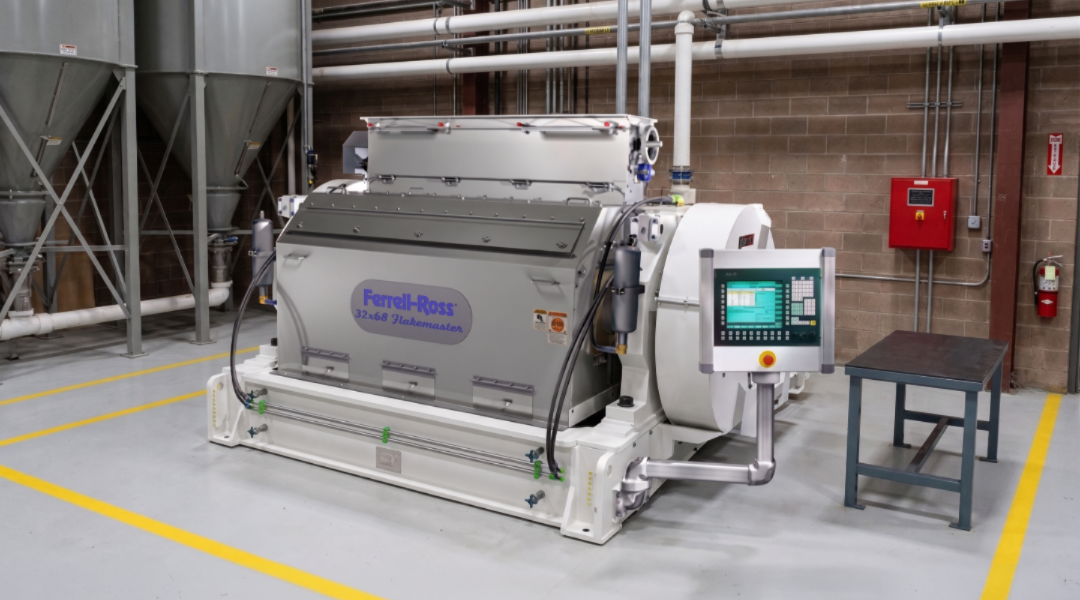
Achieving consistent results in an oilseed facility relies on the ability to manage variables throughout the entire line. Our flaking mills, including the 32×84, are designed for high-capacity, dependable operation. When you integrate these machines into a facility equipped with modern automation, you create a baseline for success that supports 500-ton-per-day operations and beyond.
Key Integration Considerations:
- Standardization: Use uniform control interfaces to simplify training and ensure that operators can manage multiple pieces of equipment effectively.
- Feedback Loops: Ensure your automation system tracks material throughput against power consumption to identify early signs of roll wear or clogging.
- Safety First: Automation should include comprehensive interlocks and emergency stop sequences that reflect global industrial safety standards, keeping the facility and its personnel protected.
Our commitment to Midwestern craftsmanship means we don’t look for quick, flimsy software fixes. We prioritize robust mechanical design—such as precise roll alignment and heavy-duty casting—as the foundation for all electronic automation. When you pair superior mechanical reduction with superior digital visibility, you create an operation that is inherently more stable.
Scaling Operations with Technical Clarity
As facilities move toward 3,000-ton-per-day or more crush volumes, the importance of accurate data grows exponentially. At this level, even a marginal increase in efficiency across your flaking line has a massive impact on the total ROI of the facility. Scaling requires more than adding machines; it requires redesigning process flows to account for higher material velocities and the increased heat and stress generated in the process.
We work with facilities to evaluate their current capacity and future expansion plans, providing the technical guidance needed to integrate automation at each stage of growth. Our engineers in Bluffton are available to discuss the complexities of your system design, from the intake and tempering stages to the final oil extraction phase. This level of collaboration is what defines the Ferrell-Ross partnership.
Conclusion
Automation is the next logical step in the evolution of the oilseed processing floor. By providing your team with better data and more responsive controls, you ensure that your facility operates at the peak of its potential. At Ferrell-Ross, we continue to bridge the gap between traditional mechanical durability and modern digital precision, offering a partnership built on integrity, expert engineering, and a deep understanding of your production needs.
Whether you are looking to refine your current process or are planning a large-scale expansion, our team is ready to discuss your requirements. We invite you to contact us at 1-800-248-8318 to learn more about our laboratory testing and custom engineering capabilities. For Oil seed questions contact Eric Svenson at extension 315. Let’s work together to optimize your facility with precision that lasts.